Arithmetic, geometric and harmonic means: which one fits?
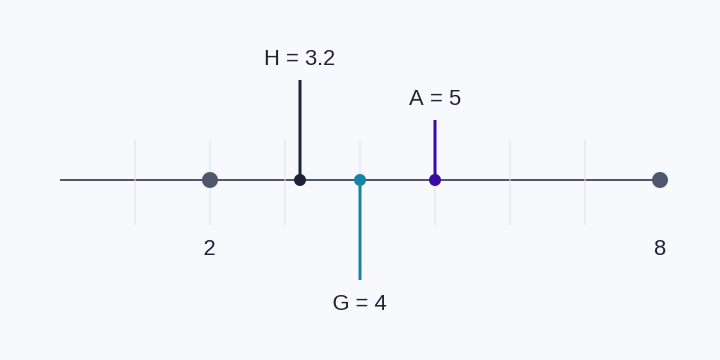
For the numbers 2 and 8, the arithmetic mean is 5, the geometric mean is 4 and the harmonic mean is 3.2. Which answer fits? I choose arithmetic, geometric or harmonic means by checking whether the problem combines amounts, growth factors or rates over equal distances.
Arithmetic, geometric and harmonic means answer different questions
An arithmetic mean divides a sum by a count. A geometric mean finds the equal factor that reproduces a product. A harmonic mean averages reciprocals and then takes the reciprocal of that average. None is a more accurate version of the others. Each preserves a different relationship in the original observations.
For a list of ordinary measurements, such as the lengths of five parts measured in millimetres, I start with the arithmetic mean. For successive proportional changes, I examine the product of the change factors. For rates over equal distances or equal quantities, I check whether the time or another denominator accumulates through reciprocals. Writing the units beside the formula often makes the choice obvious.
| Mean | Formula | Question it answers |
|---|---|---|
| Arithmetic | sum(x) / n | What equal value preserves the total? |
| Geometric | exp(sum(log(x)) / n) | What equal positive factor preserves the product? |
| Harmonic | n / sum(1 / x) | What rate gives the same total time over equal distances? |
Work one list three ways
Take the positive values 2 and 8. Their sum is 10, so the arithmetic mean is 10 / 2 = 5. Their product is 16, so the geometric mean is sqrt(16) = 4. Their reciprocals are 0.5 and 0.125; the harmonic mean is 2 / (0.5 + 0.125) = 3.2.
The three results are 5, 4 and 3.2, despite using the same observations. The arithmetic mean preserves the sum: two copies of 5 total 10. The geometric mean preserves the product: two copies of 4 multiply to 16. The harmonic mean preserves the reciprocal sum: two copies of 1 / 3.2 sum to 0.625. This is the distinction I use when explaining why the outputs disagree.
Equal distance and equal time give different speed averages
Imagine travelling 15 kilometres at 30 kilometres per hour, then another 15 kilometres at 60 kilometres per hour. The first part takes 15 / 30 = 0.5 hours. The second takes 15 / 60 = 0.25 hours. Total distance is 30 kilometres and total time is 0.75 hours, so the overall speed is 30 / 0.75 = 40 kilometres per hour.
The harmonic mean gives the same result: 2 / (1 / 30 + 1 / 60) = 40. The arithmetic mean, 45, is wrong for this equal-distance question because more time was spent travelling at the slower speed. The slower rate contributes more to the accumulated time.
Now change the question to half an hour at each speed. The distances are 15 and 30 kilometres. Together they give 45 / 1 = 45 kilometres per hour. Equal time makes the arithmetic mean appropriate. For unequal time intervals, use a weighted arithmetic mean with the interval durations as weights. For unequal distances, compute total distance divided by total time; the unweighted harmonic output here assumes equal distances.
Geometric means apply to factors, not raw percentage changes
A sequence of proportional changes is multiplicative. Suppose a hypothetical quantity increases by 25% in one equal interval, then decreases by 20% in the next. Its factors are 1.25 and 0.8. Their product is 1.25 × 0.8 = 1, so the quantity ends where it started.
The geometric mean of those factors is sqrt(1) = 1. That corresponds to zero change per interval. Averaging the raw percentages gives (25 - 20) / 2 = 2.5%, which does not reproduce the unchanged final quantity. In the average calculator, enter the factors 1.25; 0.8, then subtract 1 from the geometric mean to obtain the equivalent fractional change.
That equal-factor interpretation assumes equal interval lengths. Different interval lengths need a duration-based model. These examples explain arithmetic only and are not financial advice. The NIST geometric-mean reference defines the positive-value calculation used here.
Positive inputs and a useful order check
This calculator shows geometric and harmonic means only when every input is strictly positive. A zero or a negative value makes both outputs unavailable in this interface, while the arithmetic mean, median and other applicable statistics still work. Do not remove a legitimate zero just to obtain an extra output. That would change your data.
For positive values, the harmonic mean is no greater than the geometric mean, which is no greater than the arithmetic mean. All three agree when every value is the same. For 7; 7; 7, each mean is 7. For 2 and 8, the order is 3.2 ≤ 4 ≤ 5. I use this as a quick arithmetic check, rather than as a rule for choosing the answer.
The NIST harmonic-mean reference defines the reciprocal formula. In the browser, a scaled reciprocal calculation avoids unnecessarily large reciprocal sums; the geometric mean uses logarithms to avoid forming a huge product. Results still use floating-point arithmetic and display up to 12 significant digits.
Check the meaning before exporting the result
- Write down the quantity, its unit and the relationship you want to preserve.
- Convert values to one unit; convert percentage changes to factors when needed.
- Paste the list and choose the decimal separator. Leave weights empty for these unweighted means.
- Calculate and compare the result with a small example you can check by hand.
- Export the CSV with your description of what the chosen statistic means.
Optional weights create a separate weighted arithmetic mean; they do not make the geometric or harmonic outputs weighted. For frequencies, grades or unequal group sizes, read the weighted-average guide. If your main concern is an unusually large observation in a list, compare the arithmetic mean with the median using the guide to mean and median before choosing a summary.
Common questions
Which mean should I use for ordinary measurements?
Use the arithmetic mean when you want the total divided equally among observations. Check that all values describe the same quantity in the same unit.
Why is average speed sometimes a harmonic mean?
For equal distances, total time is the sum of distance divided by each speed. Total distance divided by that time gives the harmonic mean of the positive speeds. Equal time intervals instead use the arithmetic mean.
Can I enter percentage changes for the geometric mean?
Convert changes to positive factors first: a 25% increase becomes 1.25 and a 20% decrease becomes 0.8. Subtract 1 from the geometric mean of the factors to obtain the equivalent fractional change.
Do the optional weights change every mean?
No. Optional weights add a weighted arithmetic mean. The geometric and harmonic means still use the original unweighted list.